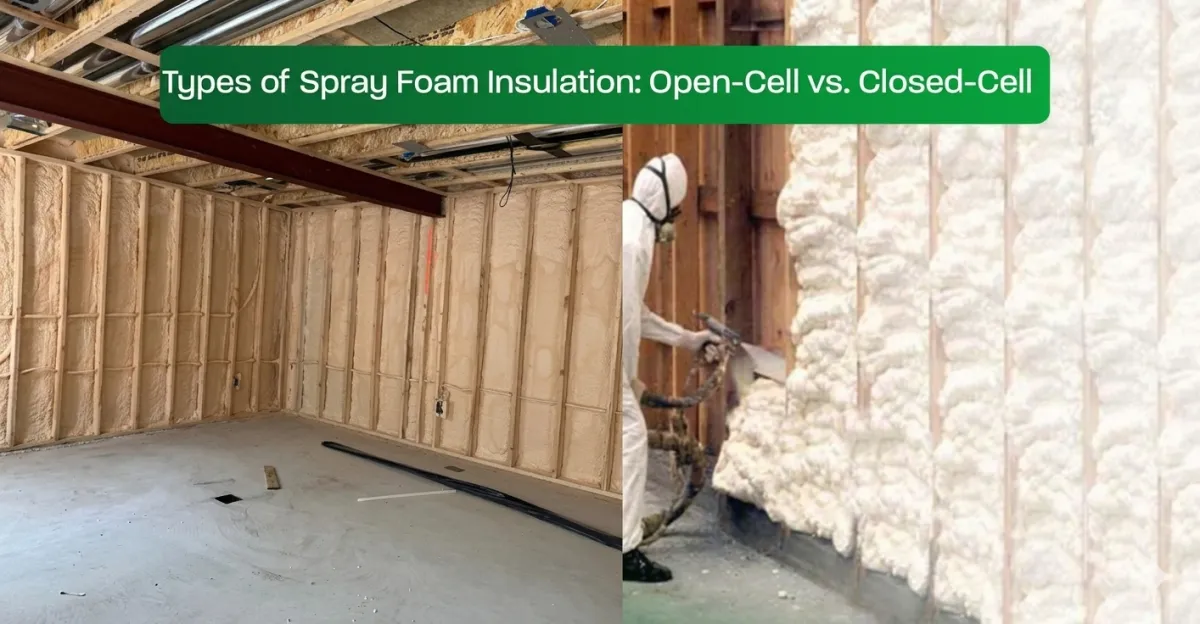
Open Cell vs Closed Cell Spray Foam
You're standing in front of an unfinished wall cavity and your contractor just asked four words that made your head spin: "open cell or closed cell?" If you're like most property owners, you know both involve spray foam insulation, but the practical differences feel unclear.
That confusion is genuinely costly. Choosing the wrong spray foam type for an application can lead to moisture damage hidden inside your walls, code violations, poor energy performance, and remediation bills that dwarf the original installation cost. Choosing correctly can lock in decades of energy savings, prevent structural damage, and support your property's value.
This guide covers the facts, comparisons, and real-world guidance you need to make a confident decision.
What Is Spray Foam Insulation?
Spray polyurethane foam (SPF) is a two-component liquid material created when isocyanate and polyol resin combine at the spray gun tip. The reaction causes the mixture to expand rapidly, filling voids and hardening into a continuous thermal and air barrier.
According to the U.S. Department of Energy, air leakage accounts for 25 to 40 percent of the energy used for heating and cooling in a typical American home. Spray foam addresses this by sealing and insulating in the same step, unlike fiberglass batts or blown-in cellulose, which insulate but leave air pathways largely intact.
The two main varieties, open cell and closed cell, share the same basic chemistry but produce very different physical structures, performance ratings, and ideal applications.
Open Cell Spray Foam: Full Breakdown
How It's Made and Why It Behaves the Way It Does
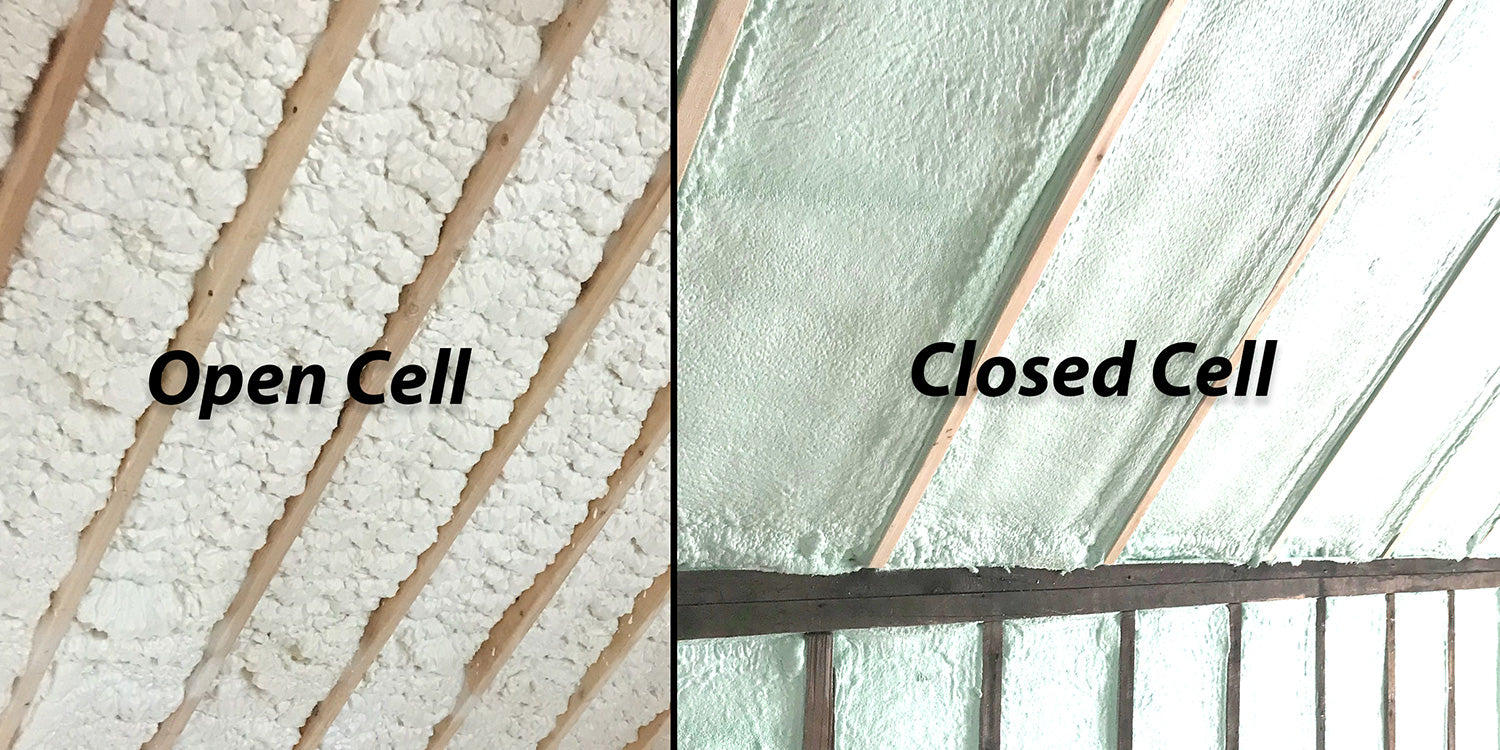
During the chemical expansion reaction in open cell foam, the cell walls intentionally break apart, leaving a network of interconnected air-filled pockets. The result is a soft, spongy material with a texture similar to a firm sofa cushion. Air is the insulating medium trapped inside those open cells.
Because the cells aren't sealed, open cell foam is vapor permeable, moisture vapor can pass through it over time. That's a design feature in some climate zones and a real liability in others.
Open Cell Foam Performance Specs
R-value per inch: approximately 3.5 to 3.7
Density: approximately 0.5 pounds per cubic foot (also called half-pound foam)
Expansion rate: expands up to roughly 100 times its original liquid volume, ideal for filling irregular cavities
Air barrier: effective at 3 or more inches of thickness
Vapor barrier: no, stays permeable to water vapor (perm rating roughly 10 to 16)
Sound control: noticeably better than fiberglass, commonly used for acoustic management between floors and rooms
The Best Applications for Open Cell Spray Foam
Interior wall cavities: full expansion fills irregular stud bays completely, and vapor permeability lets walls dry to the interior if moisture gets into the assembly.
Hot and humid climate zones (1 through 3): Building Science Corporation research notes that vapor-open assemblies are often safer in warm climates, where inward vapor drive during summer makes vapor-closed assemblies riskier.
Attics in southern U.S. states: applied to the underside of roof decking, open cell foam creates an unvented attic assembly that improves HVAC efficiency without trapping moisture.
Interior ceilings and floors for sound control: between living floors or below media rooms, open cell foam reduces sound transmission at a lower cost than closed cell.
Budget-sensitive projects in mild climates: where maximum R-value per inch isn't the top priority, open cell delivers strong air sealing at a meaningfully lower installed cost.

Closed Cell Spray Foam: Full Breakdown
How It's Made and Why It Outperforms in Demanding Applications
In closed cell foam, the cell walls stay fully intact after the expansion reaction. Each bubble is permanently sealed, creating a rigid, dense matrix. The cells are filled with a low-conductivity blowing agent rather than plain air, which is why closed cell foam achieves nearly twice the R-value per inch of open cell foam.
The sealed structure also makes closed cell foam inherently resistant to both liquid water and water vapor, the defining property that makes it the right choice for moisture-vulnerable applications.
Closed Cell Foam Performance Specs
R-value per inch: approximately 6.0 to 7.0, among the highest of any commercially available insulation material
Density: approximately 2 pounds per cubic foot (also called two-pound foam)
Expansion rate: expands roughly 30 to 60 times its liquid volume, less expansion than open cell, but dramatically greater rigidity and density
Air barrier: achieved at just 1 inch of thickness in most applications
Vapor barrier: yes, meets Class II vapor retarder requirements at 2 or more inches of thickness
Structural benefit: measurably increases wall racking strength and roof uplift resistance in high-wind regions
The Best Applications for Closed Cell Spray Foam
Basements and crawl spaces: below-grade spaces face continuous moisture pressure from surrounding soil. Closed cell foam applied to foundation walls and rim joists prevents condensation, mold growth, and structural wood decay.
Cold and mixed climate zones (4 through 8): higher R-value per inch matters where winter heating loads are significant and wall cavities are thin. Closed cell is often the only product that meets code-minimum R-values in a single pass within a 2x4 wall cavity.
Metal buildings, barns, and agricultural structures: metal panels conduct heat and cold aggressively, and interior condensation on metal surfaces is a persistent, destructive problem. Closed cell foam bonds directly to bare metal, blocking condensation and adding structural rigidity to panels.
Roof decking and spray foam roofing systems: closed cell SPF has a track record as a commercial and residential roofing material going back more than 50 years. The Spray Polyurethane Foam Alliance (SPFA) maintains technical resources on SPF roofing systems.
Coastal and flood-prone properties: closed cell foam resists water absorption and retains its thermal performance even after flood exposure. Check flood risk at the FEMA Flood Map Service Center.
Commercial construction under ASHRAE 90.1: modern commercial energy codes require continuous insulation values that closed cell foam can achieve in a single product layer.
Open Cell vs Closed Cell: The Complete Comparison Table
R-Value Explained: Why Every Decimal Point Matters
R-value is the standard measure of thermal resistance. The higher the number, the better a material resists heat flow. In the open cell vs closed cell decision, that difference isn't abstract. It directly determines whether a wall assembly meets code, how thick the insulation layer needs to be, and how much energy the property consumes for decades.
Minimum R-Value Requirements by Climate Zone
The IECC Climate Zone Map via Pacific Northwest National Laboratory divides the U.S. into zones 1 through 8 by temperature and humidity. Climate zone determines the minimum R-values code requires:
Zones 1-2 (hot humid: South Florida, Hawaii): wall minimum R-13, attic R-30 to R-38
Zones 3-4 (mixed: Southeast, Pacific Northwest): wall R-13 to R-20, attic R-38 to R-49
Zones 5-8 (cold to subarctic: Midwest, Mountain West, Alaska): wall R-20 or more, attic R-49 to R-60
In a standard 2x4 stud wall with a 3.5-inch cavity, open cell foam fills the space to roughly R-13. Closed cell foam in that same cavity reaches R-21 to R-24. In climate zones 5 through 8, closed cell is generally the only option that gets a 2x4 wall to code-minimum without adding exterior continuous insulation.
Moisture Management: The Factor That Determines Long-Term Building Health
Moisture management is where the open cell vs closed cell decision becomes most consequential. Choosing incorrectly doesn't show up on the energy bill. It shows up as mold, rotting structural members, and envelope failures, sometimes years after installation and at real remediation cost.
Vapor Permeability and Why It Determines Which Foam You Need
A vapor retarder controls how water vapor moves through a building assembly. Open cell foam has a perm rating of roughly 10 to 16, classifying it as vapor-open, moisture vapor passes through it freely.
Closed cell foam at 2 inches or more has a perm rating below 1.0, classifying it as a Class II vapor retarder under the International Residential Code (IRC). That substantially restricts vapor movement without requiring an additional membrane, simplifying the wall assembly and potentially lowering total installed cost in vapor-sensitive applications.
Climate-Specific Guidance on Vapor Control
Hot, humid climates (zones 1-3): vapor-open assemblies using open cell foam can actually be safer. Warm, humid outdoor air pushes vapor inward during summer, and a vapor-closed layer can trap that moisture inside the wall, accelerating decay. Open cell foam lets walls dry to the interior.
Cold climates (zones 5-8): interior warm air pushes vapor outward toward cold sheathing in winter. A vapor retarder on the warm side of the wall matters here. Closed cell foam serves this function; without it, a separate vapor retarder membrane is required by code.
Mixed climates (zone 4): both products can work, but the specific wall assembly design matters. Consult a certified building performance specialist for the exact location.
Cost Comparison: What You Actually Pay Per Board Foot

Price is the first question most clients ask, and it deserves a direct answer. But cost per board foot only tells part of the story. Total cost of ownership over a 20 to 30 year building life often tells a different one.
Typical Installed Costs
Open cell spray foam: $0.44 to $0.65 per board foot (1 square foot at 1-inch depth)
Closed cell spray foam: $1.00 to $1.50 per board foot
For a typical 1,500 square foot home insulating exterior walls at 3.5 inches, expect roughly $2,300 to $3,400 for open cell or $5,250 to $7,875 for closed cell. That gap is real, but it doesn't capture the whole financial picture.
Why Closed Cell Often Delivers Superior Long-Term Return
Energy savings compound over decades: a wall consistently insulated to R-21 outperforms one at R-13 every month for the life of the building. Over 20 years in a cold climate, the cumulative energy cost difference frequently exceeds the initial premium paid for closed cell foam.
Moisture damage is avoided entirely: a single mold remediation event in a wall cavity commonly costs $5,000 to $30,000 or more. Properly specified closed cell foam in a moisture-vulnerable location is inexpensive insurance by comparison.
Secondary products are eliminated: when closed cell foam acts as both insulator and vapor retarder, you skip the cost of a separate vapor barrier membrane and its installation labor.
Structural benefit has measurable value: the added racking strength and roof uplift resistance reduces the risk of storm-related structural damage, a tangible benefit in high-wind regions.
Which Spray Foam Is Right for Your Situation?
For Residential Homeowners
Your optimal choice depends on climate zone, the specific location in the home, and budget:
Attic in climate zones 1-3: open cell foam on the underside of roof decking. Allows drying to the interior, cost-effective, excellent air sealing.
Attic in climate zones 5-8: closed cell foam, or a hybrid approach with a thin closed cell layer followed by open cell, for both R-value and vapor control.
Exterior walls in a 2x4-framed cold-climate house: closed cell foam to reach code-minimum R-value within the existing cavity depth.
Interior partition walls for sound reduction: open cell foam, for noticeably better acoustic performance at lower cost than closed cell.
Basement walls and rim joists: closed cell foam, without exception, in any climate zone, due to below-grade moisture exposure.
Crawl spaces: closed cell foam on perimeter walls and, depending on assembly design, on the subfloor above.
For Agricultural and Rural Property Owners
Barns, poultry houses, livestock confinement buildings, grain storage facilities, and equipment sheds have demanding requirements: extreme temperature swings, high humidity, constant pest pressure, and structures that need to perform for decades with minimal maintenance.
Closed cell spray foam is the standard recommendation for agricultural applications because it:
Bonds permanently to metal roofing and siding panels, eliminating the interior condensation that causes rust from the inside out
Resists moisture from animal respiration, manure gases, and periodic wash-down events without absorbing or transmitting vapor
Deters rodent nesting more effectively than fibrous insulation, which provides ideal nesting material for mice and rats
Adds structural rigidity that reinforces pre-engineered metal building panels against wind and snow load
Maintains full thermal performance across the extreme temperature swings common in Midwest and Great Plains agricultural facilities
Many farm operators report meaningful heating and cooling cost reductions after switching to spray foam, commonly cited in the 20 to 40 percent range depending on the building's starting condition. The USDA's Rural Energy for America Program (REAP) offers guaranteed loans for qualifying energy efficiency upgrades including insulation; as of this writing, REAP grant applications are paused while USDA finalizes updated program regulations, so check current status before assuming grant funding is available.
For Commercial and Business Property Owners
Commercial construction operates under ASHRAE 90.1 energy codes that frequently exceed residential minimums. Continuous insulation requirements, thermal bridging rules, and roofing performance mandates often steer commercial projects toward closed cell foam as the most efficient single product to meet code.
Spray foam roofing using closed cell SPF has a documented performance history, commonly cited at 30-plus years with proper maintenance and UV-protective coatings. The National Roofing Contractors Association maintains technical guidance on SPF roofing systems worth reviewing before committing to a product.
A common hybrid strategy for commercial walls is a closed cell layer directly against the exterior sheathing for vapor control and continuous insulation, with the remainder of the cavity filled in open cell for acoustic benefit and thermal continuity.
For General Contractors and Builders
A quick specification framework across most project types:
Below grade (foundations, basements, crawl spaces): closed cell, without exception
Cold-climate exterior walls with thin cavities: closed cell for code compliance on R-value
Warm-climate exterior walls with standard cavity depth: open cell is acceptable; verify with the local authority having jurisdiction
Interior partitions for sound control: open cell, notably more cost-effective
Metal building envelopes: closed cell for condensation control and direct adhesion to metal substrates
Attics in hot climates: open cell on the underside of roof decking, unvented assembly
Attics in cold climates: closed cell, or a hybrid assembly designed to the climate zone
Commercial roofing: closed cell SPF with a UV-protective elastomeric topcoat
Environmental Considerations
Spray foam has faced legitimate environmental scrutiny, mainly around the blowing agents used to expand closed cell foam. Historically, hydrofluorocarbon (HFC) blowing agents carried high global warming potential (GWP). The industry has made real progress here.
Open cell foam uses water or CO2 as its blowing agent, carrying negligible global warming potential, the lower-embodied-carbon option of the two.
Closed cell foam manufacturers have increasingly moved to hydrofluoroolefin (HFO) blowing agents with GWP values of 1 to 2, compared to values exceeding 1,000 for legacy HFC products. Ask a contractor which generation of blowing agent is in the product they plan to install.
Bio-based open cell foam options made with soy or castor oil-derived polyols are commercially available and may qualify for green building credits under LEED certification programs or local energy incentive programs.
The EPA's energy efficiency resources consistently show that reducing a building's operational energy consumption is one of the most impactful levers for lowering lifetime carbon emissions. The energy savings from properly installed spray foam commonly offset the embodied carbon of the foam material within a few years of occupancy.
Five Common Spray Foam Mistakes That Cost Property Owners Thousands
Mistake 1: Installing open cell foam below grade. Open cell foam absorbs groundwater vapor over time in below-grade environments, degrading its R-value, promoting persistent mold conditions, and accelerating wood decay in the framing above. Closed cell foam is the correct choice for any below-grade application.
Mistake 2: Applying closed cell foam too thin in cold climates. Closed cell foam doesn't reach Class II vapor retarder performance until it hits roughly 2 inches of installed thickness. A contractor who sprays only 1 inch in a cold-climate wall assembly leaves the sheathing vulnerable to interstitial condensation. Verify thickness against local code and the installer's product data sheet.
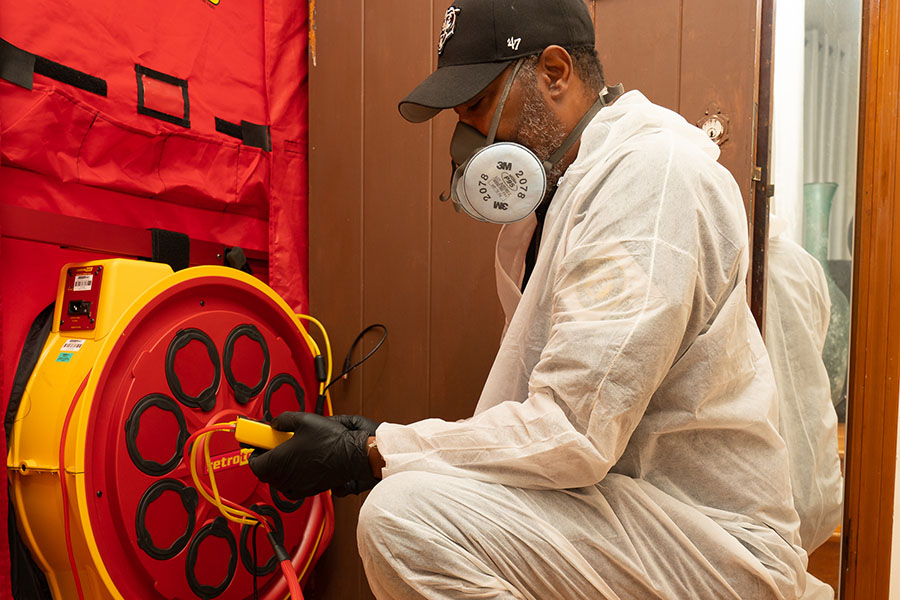
Mistake 3: Skipping the post-installation blower door test. Spray foam's core value is comprehensive air sealing. A blower door test verifies that the foam actually achieved a continuous air barrier, without it, you're relying solely on the contractor's word. The Building Performance Institute (BPI) maintains a directory of certified building analysts who provide independent testing.
Mistake 4: Selecting foam type based mainly on upfront price. Choosing open cell for a moisture-vulnerable location to save a couple thousand dollars upfront is a false economy when a single mold remediation event in that same cavity can cost $8,000 to $25,000. Match the product to the application first, then negotiate price within the right product category.
Mistake 5: Hiring an uncertified installer. Spray foam is a precision application. Off-ratio chemical mixing, wrong substrate temperatures, inadequate thickness, and improper ventilation during application all cause performance failures that are difficult and expensive to fix afterward. Work with installers holding current SPFA certification or an equivalent credential recognized in your state.
Frequently Asked Questions
Can you use both open cell and closed cell foam in the same building?
Yes, and this hybrid approach is common and often smart. Many builders use closed cell foam at the rim joist and below-grade foundation walls for moisture control, then open cell in interior wall cavities and attic spaces for cost efficiency and sound reduction. The two products don't need to be in direct contact to perform correctly.
How long does spray foam insulation last?
Both types are engineered to last the lifetime of the building when installed correctly. Closed cell foam resists physical damage better because of its rigidity, but open cell foam in a protected wall cavity can maintain thermal performance for many decades without replacement.
Is spray foam safe after it fully cures?
Yes. Once fully cured, typically within 24 hours, both types are chemically inert and safe for occupants. The installation process itself requires occupant evacuation and full PPE for applicators. The EPA's spray polyurethane foam safety guidance covers re-entry times and ventilation requirements in detail.
Does spray foam insulation increase home resale value?
Energy-efficient homes generally sell faster and command a premium compared to similar homes with inadequate insulation, a pattern the National Association of Realtors has tracked across housing market research. A well-documented spray foam installation with verified blower door test results is a tangible, marketable asset in an energy-conscious housing market.
What is the correct spray foam for a metal agricultural building?
Closed cell foam, without exception. It bonds directly to bare metal, acts as a vapor retarder that prevents the interior condensation causing rust and corrosion from the inside out, and adds structural rigidity to metal panel systems. Open cell foam should never go directly against metal surfaces in any climate zone.
What R-value should my attic have?
The Department of Energy recommends R-38 to R-60 for most U.S. attics depending on climate zone. Use the DOE insulation guidance to find a location-specific target.
The Final Verdict: Matching the Right Foam to Your Project
There's no universally correct answer in the open cell vs closed cell decision, only the right product for the right application, in the right climate, at the right thickness.
Choose open cell foam for cost-effective air sealing and insulation in interior walls, hot-climate attics, sound control partitions, or large irregular cavities in mild climate zones.
Choose closed cell foam for maximum R-value within a thin cavity, moisture and vapor resistance, below-grade performance, metal building envelopes, coastal or flood-zone durability, or commercial construction compliance.
Consider a hybrid assembly when budget, cavity dimensions, and performance targets all need to be balanced on the same project.
The most useful next step is a professional site assessment with a certified spray foam contractor who can evaluate your specific building, climate zone, and performance goals in person. Driftless Foam offers free assessments for exactly this kind of decision, and can also walk you through how spray foam compares to fiberglass and cellulose if you're still weighing insulation types more broadly.
