Improve Comfort with Ceiling Spray Foam Insulation - Driftless Foam
If an upstairs bedroom turns into an oven every summer, a room feels cold and drafty near the ceiling in winter, or noise travels easily between floors, the problem may not be your HVAC system. In many homes, the issue starts with inadequate insulation or air sealing around the ceiling.
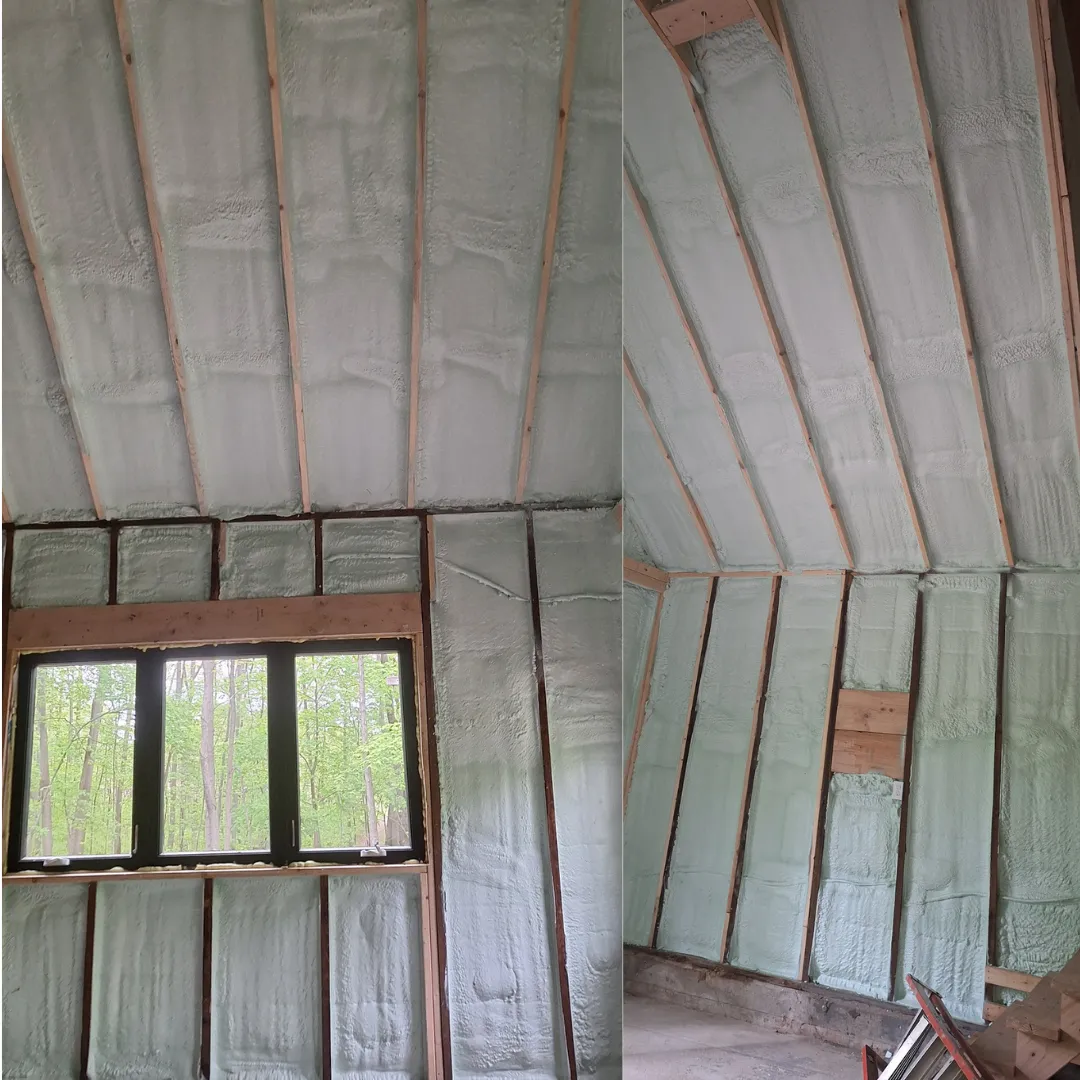
Ceiling spray foam insulation can help address these problems by creating an insulation layer and an air seal in the same application. It can be especially useful for vaulted ceilings, converted attic rooms, additions, and other areas where traditional attic-floor insulation does not adequately protect the living space.
What Is Ceiling Spray Foam Insulation?
Ceiling spray foam insulation refers to spray-applied insulation installed in a ceiling cavity or directly against the underside of a roof deck. Instead of simply laying insulation across an attic floor, spray foam can be applied where the ceiling itself forms part of the building envelope.
This distinction matters because not every ceiling has an accessible attic space above it.
A standard flat ceiling may have an open attic above it, allowing insulation to be installed across the attic floor. But vaulted ceilings, cathedral ceilings, converted attic rooms, dormers, and some additions may follow the roofline directly. In these situations, insulation may need to be installed along the roofline or within the ceiling cavity.
Spray foam expands into gaps around framing, penetrations, and other difficult-to-insulate areas. This allows it to provide both insulation and air sealing as part of the same application.
Why an Insulated Attic Does Not Always Mean an Insulated Ceiling
One of the most common misconceptions homeowners have is that if their attic contains insulation, every ceiling below it must already be adequately insulated.
That is not necessarily the case.
If you have a standard flat ceiling with an open attic above it, attic-floor insulation may provide the separation needed between the living space and the unconditioned attic.
However, the situation changes with a vaulted ceiling, converted attic, dormer, or addition where the roofline forms the ceiling of the room.
In these areas, there may not be a traditional attic floor that can be insulated. The insulation needs to be installed within the ceiling assembly or along the underside of the roof deck instead.
Air leakage can also contribute to comfort problems. Heat and conditioned air can move through gaps around ceiling fixtures, framing, electrical penetrations, and areas where the ceiling meets walls. Even a ceiling with insulation can perform poorly if it has significant air leakage.
How Spray-Applied Ceiling Insulation Works
Spray foam is applied directly into the ceiling cavity or against the appropriate roofline assembly. As the material expands, it fills gaps and irregular spaces that can be difficult to seal with traditional insulation.
This makes spray-applied ceiling insulation useful for areas where creating a continuous insulation and air-sealing layer is difficult.
Depending on the project, spray foam may be used around ceiling joists, between rafters, or along a roofline. The correct application depends on the construction of the home, the location of the insulation, moisture conditions, and the specific goals of the project.
A professional assessment is important because ceiling and roof assemblies can have different insulation and ventilation requirements.
Where Can Spray Foam Be Used for Ceiling Insulation?
Standard Ceiling Cavities
Spray foam can be used in ceiling cavities where improved air sealing and insulation are needed. Its ability to expand around framing and penetrations can help reduce the gaps that allow unwanted air movement.
Vaulted and Cathedral Ceilings
Vaulted ceilings can be more challenging to insulate because the ceiling follows the roofline and may have limited cavity space.
Spray foam can be applied between the appropriate framing members to create an insulation and air-sealing layer. The type and thickness of foam required depend on the specific roof and ceiling assembly.
For homeowners considering spray foam for a vaulted ceiling, it is important to evaluate the entire assembly rather than simply selecting an insulation material.
Attic Ceilings and Rooflines
An attic can be insulated at the floor or at the roofline, depending on how the space is used and how the building envelope is designed.
If an attic is part of the conditioned space, insulation along the roofline may be appropriate. If the attic is an unconditioned space above a standard flat ceiling, insulation across the attic floor may be the more relevant application.
This is why determining where the insulation belongs is just as important as selecting the insulation itself.
Ceiling Joists and Difficult-to-Reach Areas
Ceiling joists, framing intersections, penetrations, and irregular cavities can create areas where traditional insulation may leave gaps.
Spray foam can expand into these spaces and create a more continuous air barrier when properly installed.
Benefits of Ceiling Spray Foam Insulation
More Consistent Indoor Temperatures
Poorly insulated ceilings can contribute to uncomfortable rooms, particularly on upper floors and beneath rooflines.
By improving the insulation and air sealing of the ceiling assembly, spray foam can help reduce unwanted heat transfer and make room temperatures more consistent.
Better Air Sealing
Insulation and air sealing are related but different functions.
Traditional insulation can reduce heat transfer without necessarily stopping air movement through every gap. Spray foam expands and bonds to surfaces, helping seal many of the small openings around framing, penetrations, and other areas.
Reducing unwanted air movement can be an important part of improving overall comfort.
Improved Comfort in Vaulted and Converted Spaces
Rooms with vaulted ceilings, converted attic spaces, and additions can have different insulation challenges from standard rooms.
If the roofline forms the boundary between the living space and the exterior, the insulation needs to address that specific assembly.
Properly installed spray foam can provide an insulation and air-sealing layer designed around the space.
Reduced Noise Transfer
Spray foam is not a complete soundproofing solution, but it can help reduce some sound transmission by filling gaps and openings within a ceiling or floor assembly.
This can be useful in homes where bedrooms are located above living areas or where sound travels easily between floors.
For significant sound-control requirements, the entire floor and ceiling assembly should be considered rather than relying on insulation alone.
Potentially Lower HVAC Workload
When unwanted heat transfer and air leakage are reduced, heating and cooling equipment may not need to compensate as heavily for those losses.
The actual energy savings depend on the existing insulation, air leakage, HVAC system, building design, weather, and other factors, so spray foam should be viewed as one part of an overall energy-efficiency strategy.
Long-Term Stability
Traditional batt insulation can shift, compress, or sag depending on the material, installation, moisture exposure, and conditions within the cavity.
Spray foam adheres to the surfaces where it is installed and is designed to remain in place. Proper installation is important to achieve the intended performance.
Open-Cell vs. Closed-Cell Spray Foam for Ceilings
Choosing between open-cell and closed-cell spray foam depends on the location and construction of the ceiling or roof assembly.
Open-cell spray foam is less dense and expands significantly during installation. It can be useful for filling larger cavities and irregular spaces and is commonly considered for interior applications where its properties are appropriate.
Closed-cell spray foam is denser and provides a higher R-value per inch. It also has different moisture-resistance characteristics, which can make it useful in certain roofline and moisture-sensitive applications.
There is no single foam type that is right for every ceiling.
The appropriate choice depends on factors such as cavity depth, moisture exposure, roof construction, local building requirements, and the performance goals of the project.
open-cell vs. closed-cell spray foam
Spray Foam vs. Fiberglass Batts for Ceiling Insulation
Both spray foam and fiberglass can be used as insulation, but they work differently.
Feature | Spray Foam | Fiberglass Batts |
|---|---|---|
Air sealing | Helps seal gaps when properly installed | Does not provide the same level of air sealing |
Irregular spaces | Expands into gaps and around framing | Can be more difficult to fit around irregular areas |
Installation around penetrations | Can seal around many penetrations | May leave gaps if not carefully fitted |
Vaulted ceiling applications | Can be suitable depending on assembly | May be more difficult in certain roofline configurations |
Moisture characteristics | Vary by foam type | Vary by product and installation |
Long-term positioning | Bonds to the application surface | Can shift or compress depending on conditions |
The biggest difference is that spray foam can provide both insulation and air sealing, while fiberglass primarily functions as an insulation material.
That does not mean spray foam is automatically the right solution for every ceiling. The existing construction and condition of the space should be evaluated before selecting an insulation system.
why spray foam can outperform traditional insulation options
Signs Your Ceiling May Need Better Insulation
Your ceiling may deserve closer inspection if you notice:
An Upstairs Room Gets Too Hot in Summer
Rooms directly below a roofline can experience significant heat gain when insulation and air sealing are inadequate.
A Room Feels Cold Near the Ceiling in Winter
Cold surfaces, drafts, or uneven temperatures can indicate insulation or air-sealing problems.
Temperatures Vary Between Rooms
If one room is consistently warmer or colder than the rest of the house despite similar thermostat settings, the building envelope may be contributing to the problem.
You Notice Drafts Around Ceiling Fixtures
Air can move through gaps around light fixtures, ceiling fans, electrical penetrations, and other openings.
A Vaulted Ceiling Is Difficult to Keep Comfortable
Vaulted and cathedral ceilings can have different insulation requirements because the roofline becomes part of the building envelope.
Sound Travels Easily Between Floors
Noise moving between floors can have multiple causes, but gaps and the construction of the floor-ceiling assembly can contribute to sound transmission.
signs your home may need spray foam insulation
How Much Does Ceiling Spray Foam Insulation Cost?
The cost of ceiling spray foam insulation varies from one project to another.
Factors that can affect the project cost include:
Total square footage
Open-cell or closed-cell foam
Required insulation thickness
Ceiling and roof construction
Accessibility of the work area
Existing insulation
Whether old insulation needs to be removed
Complexity of the ceiling or roofline
Preparation and finishing requirements
A simple ceiling cavity and a complex vaulted roofline should not be expected to have the same installation cost.
The best way to determine the cost for your home is to have the area evaluated and receive a project-specific quote.
Frequently Asked Questions About Ceiling Spray Foam Insulation
Is spray foam good for ceiling insulation?
Spray foam can be an effective option for ceiling insulation when the material and installation method are appropriate for the specific ceiling or roof assembly. It can provide both insulation and air sealing.
Can you spray foam an existing ceiling?
In some situations, spray foam can be installed in an existing ceiling or roofline assembly. The feasibility depends on how the ceiling is constructed, whether the cavity is accessible, and what existing insulation or materials are present.
Is closed-cell spray foam good for ceilings?
Closed-cell spray foam can be appropriate for certain ceiling and roofline applications, particularly where its higher R-value per inch and moisture-related properties are beneficial. The correct choice depends on the assembly.
Is spray foam suitable for vaulted ceilings?
Spray foam can be used in certain vaulted and cathedral ceiling assemblies. Because these applications involve the roofline, the existing construction, ventilation, moisture conditions, and applicable building requirements should be evaluated before installation.
Can spray foam help with a hot upstairs room?
If inadequate insulation or air leakage is contributing to the temperature problem, improving the ceiling or roofline insulation may help make the room more comfortable. However, HVAC capacity, ductwork, windows, shading, and other factors can also affect room temperature.
Does spray foam reduce noise through a ceiling?
Spray foam can help reduce some sound transmission by sealing gaps and openings, but it should not be considered a complete soundproofing system. The entire floor-ceiling assembly affects acoustic performance.
Is ceiling spray foam better than fiberglass?
The answer depends on the application. Spray foam provides insulation and air-sealing properties, while fiberglass is primarily an insulation material. The appropriate option depends on the ceiling construction, project goals, budget, and local requirements.
Fix the Room That's Actually Bothering You
You may not need to reinsulate your entire home to address one uncomfortable room.
If an upstairs bedroom overheats every summer, a vaulted living room feels cold in winter, or a converted space never seems comfortable, the ceiling or roofline may deserve closer attention.
The right insulation approach depends on how your home is constructed and where the actual air and heat-transfer problems are occurring.
